

You sit with your books for hours.
You underline, highlight, reread, maybe even feel productive.
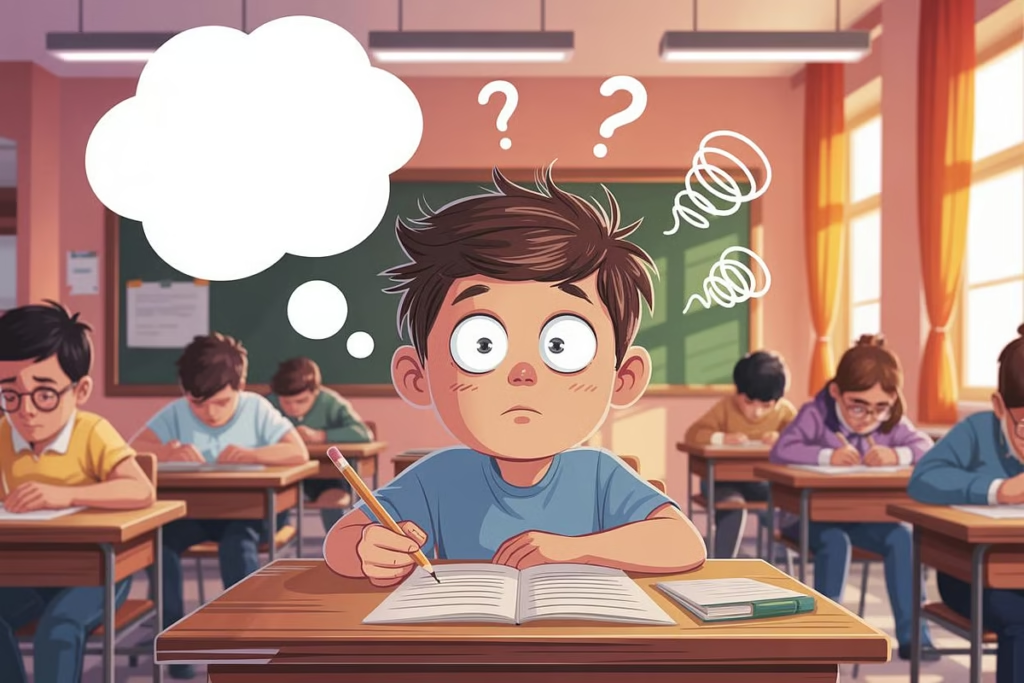
And yet—
When it’s time to recall… your mind goes blank.
This is not a discipline problem.
It’s not even a “hard work” problem.
It’s a how-your-brain-actually-learns problem.
⚠️ The Brutal Truth
Most students are not learning.
They are just exposing themselves to information.
Reading ≠ Learning
Highlighting ≠ Understanding
Revising ≠ Remembering
Your brain doesn’t reward effort.
It rewards encoding and retrieval.
🧠 What’s Really Happening Inside Your Brain
Memory works in three stages:
- Encoding – How you take in information
- Storage – How it is organised
- Retrieval – How you access it later
Most students fail at the first and third.
They:
- Passively read (weak encoding)
- Never test themselves (no retrieval pathways)
Result?
Information never becomes memory.
🚫 The Biggest Mistake: Passive Learning
Let’s be precise.
If your study looks like this:
- Reading chapters repeatedly
- Highlighting lines
- Watching videos continuously
- Copying notes
Then you are in passive mode.
Passive learning creates an illusion:
“I understand this.”
But understanding without recall is useless.
🔍 The Illusion of Familiarity
Ever experienced this?
- You read a page → feels easy
- You reread → feels even easier
- You think → “I know this”
Then in the exam:
👉 Nothing comes.
This is called recognition, not recall.
Your brain says:
“I’ve seen this before”
Not
“I can produce this independently”
That difference is everything.
⚡ The Real Reason You Forget Everything
Because you are not forcing your brain to:
- Struggle
- Retrieve
- Reconstruct
Memory strengthens only when:
Recall is effortful
No struggle → No memory
🔥 The 5-Step Fix (Scientifically Proven)
1. Stop Rereading — Start Retrieving
Close the book.
Ask yourself:
- “What did I just learn?”
Write it. Speak it. Recall it.
2. Use Active Recall (Your #1 Weapon)
Instead of:
👉 Reading notes
Do:
👉 Ask questions without looking
Example:
- “Explain this concept in 2 lines”
- “Derive this formula”
- “Why does this happen?”
3. Space Your Learning
Your brain forgets fast—but that’s useful.
Use it.
Study like this:
- Day 1 → Learn
- Day 2 → Recall
- Day 4 → Recall again
- Day 7 → Test
This is called Spaced Repetition.
4. Interleave Subjects
Don’t study one topic for 5 hours.
Mix:
- Physics + Maths
- Theory + Problems
This builds stronger neural connections.
5. Teach What You Learn
If you cannot explain it simply:
👉 You don’t know it.
Use:
- Self-teaching
- Imaginary classroom
- Peer explanation
Teaching = Highest level of learning
💡 The “3-Hour Rule” That Changes Everything
Studying 10 hours passively = Waste
Studying 3 hours actively = Transformation
Ask yourself:
“Was I struggling to recall… or just reading comfortably?”
Comfort is the enemy of memory.
🧭 The Shift You Must Make
From:
- Reading → Recalling
- Highlighting → Testing
- Understanding → Producing
🎯 Final Reality Check
If you study all day and remember nothing:
It doesn’t mean you are weak.
It means your method is.
Change the method—
And your results will change faster than you expect.
🔥 One Line to Remember
“Learning is not what you read. It is what you can retrieve.”
Discover more from EduSpark.Blog
Subscribe to get the latest posts sent to your email.
